Dogwood Borer and Apple Trees

The dogwood borer, Syanthedon scitula (Harris) (fig. 1), is from the Family Sesiidae, the family of clearwing moths. Adult clearwings are colorful, day-flying moths that bear close resemblance to wasps. Although they cannot sting, this mimicry no doubt protects them from birds and other predators. They live in all parts of the United States east of the Rocky Mountains.

Figure 1. Adult dogwood borer moth. Photo: Henry W. Hogmire, Jr., West Virginia University.
Adult dogwood borer moth. Photo courtesy of Henry W. Hogmire, Jr., West Virginia University.

The dogwood borer has been considered an …

Table of Apple Cultivar Susceptibility to Powdery Mildew

Powdery mildew on apple is a fungus disease caused by Podosphaera leucotricha. It can be a persistent disease of susceptible apple cultivars wherever apples are grown. It is the only fungal apple disease that is capable of infecting without wetting from rain or dew. Mildew severity and the need for control measures are related to cultivar susceptibility and intended fruit market. The table below lists the relative powdery mildew susceptibility of numerous apple cultivars. 

 
Apple cultivar Powdery mildew susceptibility rating

X-Spot of Apple

The names X-spot, X-rot, and Nigrospora spot have been applied to a small, circular, depressed, necrotic spot typically on the calyx end of apple fruit in the mid-Atlantic region (Fig. 1). Although uncommon, incidence of X-spot as high as 86% was reported on unprotected ‘Golden Delicious’ and ‘Rome Beauty’ fruit in 1950. Other susceptible cultivars include ‘Jonathan’, ‘Stayman Winesap’, and ‘York Imperial’.

Figure 1. X-spot is likely a fungal disease, although the pathogen is undetermined at this time. Photo: A.

Black Rot of Apple

Black rot is a fungus disease that can cause serious losses in apple orchards, especially in warm, humid areas. The black rot fungus covers a wide geographical range and can infect many hosts other than apple. The role these hosts play in the spread and development of the disease is not known. Three forms of the disease can occur: a leaf spot known as frogeye leaf spot, a fruit rot, and a limb canker. Severe leaf spotting can result in …

Hail Injury on Apple Trees and Fruit

Hail can injure apple fruit, shoots, and limbs. The extent of the injury usually depends on the size and shape of the hail and the duration of the event. Injury can range from torn or shredded leaves and small dents that don’t break the fruit skin to effects so severe that an entire crop is lost due to physical damage. In some cases, replacement of trees is necessary, especially when young trees have significant bark injury. Fungicide protection of injured …

Sources for Apple and Other Fruit Trees

Many nurseries supply fruit trees to commercial and home growers. We’ve assembled lists of some of these nurseries to help you source particular plant material or locate nurseries in your region. As Cooperative Extension educators, our goal is to provide you with basic information and resources to make informed decisions. These lists are for informational purposes only. They are neither comprehensive nor intended to promote any individual businesses.

U.S. Fruit Tree Nurseries

International Fruit Tree Nurseries

Fruit Tree Rootstock Nurseries

Fire Blight of Apple

Fire blight

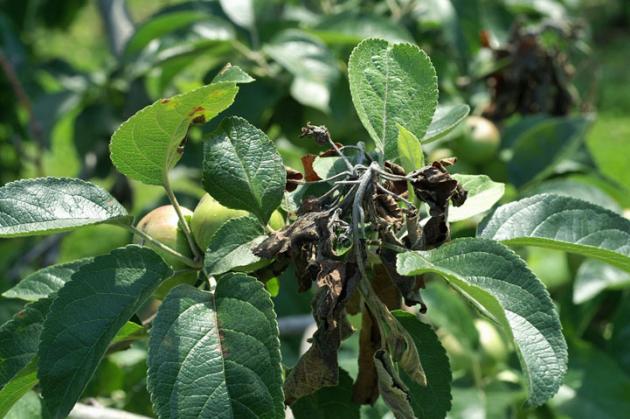
Figure 1. Blossom cluster and adjacent shoot with fire blight. (Alan R. Biggs, West Virginia University)

Fire blight is a destructive bacterial disease of apples and pears that kills blossoms, shoots, limbs, and, sometimes, entire trees (Figs. 1, 2). The disease is generally common throughout the United States wherever apples are grown. Outbreaks are typically very erratic, causing severe losses in some orchards in some years and little or no significant damage in others.

Fire blight

Figure 2. Apple shoot with fire …

Latent Viruses in Apples

A large number of latent viruses have been identified in apple. More common latent viruses include apple chlorotic leaf spot virus, apple stem pitting virus, and apple stem grooving virus. These viruses also cause diseases in other fruit crops. Apple chlorotic leaf spot virus causes pear ring pattern mosaic and has been found in all pome and stone fruit species. Apple stem pitting virus is the causal agent of pear vein yellows.

As the designation “latent” implies, these viruses are …

Table of Apple Cultivar Susceptibility to Bitter Rot


Bitter rot is a fungus disease that causes fruit rot during the summer and the preharvest period. The bitter rot fungi are almost worldwide in distribution and cause an especially economically important disease in the southern United States. Outbreaks can occur rapidly, and losses can be severe, especially under prolonged warm, wet weather. This table lists the bitter rot susceptibility rating of many popular apple cultivars.

Apple cultivar

Bitter rot
susceptibility ratingz

Apple cultivar

Bitter rot
susceptibility ratingz

Table of Apple Cultivar Susceptibility to Quince Rust


Quince rust is a fungus disease caused by Gymnosporangium clavipes. The fungus infects fruit, but not leaves, of most apple cultivars. It infects both fruit and leaves of hawthorn. This table lists the quince rust susceptibility of numerous apple cultivars.

Apple cultivar Quince rust
susceptibility ratingz
Apple cultivar Quince rust
susceptibility ratingz
Ambrosia HS Milton R
Arkansas Black HS Mutsu R
Arlet S Northern Spy R
Baldwin R Orin R
Ben Davis R Paulared R
Braeburn S Pinova