U.S. Fruit Tree Nurseries

Adams County Nursery Inc., 26 Nursery Rd., P.O. Box 108, Aspers, PA 17304 http://www.acnursery.com/

Agri-Sun Nursery, 15935 S. Temperance Ave., Selma, CA 93662

Banning Orchards and Nursery, 4000 Grant Rd., East Wenatchee, WA 98802

Boyer Nursery & Orchards Inc., 405 Boyer Nursery Rd., Biglerville, PA 17307 http://www.boyernurseries.com/

Brandt’s Fruit Trees Inc., P.O. Box B, Parker, WA 98939 http://brandtsfruittrees.com/

Burchell Nursery Inc., 12000 State Highway 120, Oakdale, CA 95361 http://www.burchellnursery.com/

Cameron Nursery, 1261 Ringold Rd., P.O. Box 300, Eltopia, WA 99330-0300 …
International Fruit Tree Nurseries

D&L Nursery, 75 Avenue Joxe, 49100 Angers, France

Janssen Brothers Nurseries Limited, PO Box 2711 6030 aa Nederweert, Holland

Jos Morren Nurseries, Bosstraat 85-85 3545, Halen, Belgium

Nakajima Tenkoen Co., No. 34, 1-Chome Nakajima dori, Higashine City, Yamagata Perf. Japan 999-37

Schrama Nursery, Prof. Zuurlaan 10, 8256 PE, Biddinghuizen, Holland

Star Fruits, Les Genets D’or, No. 14, 84430 Mondragon, France

Viveros Requinoa, Victoria Subercaseaux No. 323, Santiago, Chile

Wiel Willems, Zuidwesterringweg 5-II, 8308 PC Nagele, Holland


As Cooperative Extension educators,

U.S. Fruit Tree Rootstock Nurseries

Brandt’s Fruit Trees, Inc., PO Box B, Parker, WA 98951 http://www.brandtsfruittrees.com

Burchell Nursery, Inc., 4201 McHenry Ave., Modesto, CA 95356 http://www.burchellnursery.com/

Cameron Nursery, 1261 Ringold Rd., PO Box 300, Eltopia, WA 99330-0300

Copenhaven Farms Nursery, 12990 SW Copenhaven Rd., Gaston, OR 97119 http://www.copenhavenfarms.com/

Cummins Nursery, 18 Glass Factory Bay Rd., Geneva, NY 14456 http://www.cumminsnursery.com/

Grootendorst Nurseries, Lakeside, MI 49116

Four Mile, 27027 South Hwy. 170, Canby, OR 97013 http://www.fourmile.com/

Lawyer Nursery, Inc., 950 Highway 200 West, Plains, MT 59859 http://www.lawyernursery.com/

Apple Scab

Apple Scab

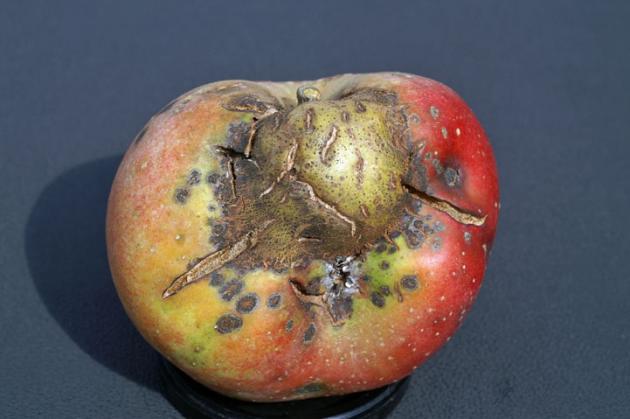
Apple scab is a fungus disease caused by Venturia inaequalis. It is of major economic importance and, if not controlled, can cause extensive losses (70% or greater) where humid, cool weather occurs during the spring months. Losses result directly from fruit or pedicel infections or indirectly from repeated defoliation, which can reduce tree growth and yield.

Symptoms

Apple scab lesions occur on leaves, petioles, blossoms, sepals, fruit, pedicels, and less frequently, on young shoots and bud scales. The first lesions …

Thread Blight of Apple

Thread blight is a fungus disease caused by Corticium stevensii. Primarily, the disease is a problem in poorly managed orchards in the southeastern United States.

Thread blight symptoms are noticeable in early summer. Leaves wilt and turn brown (fig. 1), usually on the interior or shaded portions of the tree. Dead, curled leaves cling to blighted branches, frequently mid-branch, with unaffected leaves remaining on both sides of the diseased area (fig. 2). In well-managed orchards, the disease usually does not …

I want to espalier an apple tree along a garage wall. What rootstock should I use?

Espalier is a technique of pruning and training apples in two dimensions, usually against a flat surface such as a wall or fence. The rootstock that you choose needs to induce enough vigor in the scion cultivar so that growth occurs but does not produce a tree with too much vigor. The environment where you are located will alter this decision. The colder, northern areas of the United States — that is, USDA hardiness zones 3 and 4 (look up …

What is fly speck, and how do I identify and manage the disease?

Fly speck and sooty blotch are surface blemish diseases caused by fungi that commonly appear together on apple or pear in late summer and fall. Although these diseases may shorten the storage life of fruit due to increased water loss, they do not cause decay, and losses are attributed to unacceptable appearance. During wet growing seasons, losses of 25% or more are commonly found even in orchards treated with fungicides. Many fungi are involved in this complex of pathogens, including …

How are finished apple trees produced in a nursery?

Here is a summary of a nursery production schedule for fruit trees:

• Late fall: Cut/dig rootstock liners.
• Early spring: Plant liners.
• Late summer: Bud rootstock liner.
• Early spring: Cut off top of rootstock liner above bud.
• Late fall: Dig finished trees.
• Early spring: Sell/ship finished trees.

See this article titled Nursery Production of Finished Apple Trees for more detailed information.

Answer provided by Robert Crassweller, Penn State University.…

Apple Root Suckers

Root suckers are apple tree sprouts that emerge from the rootstock. They grow around the base of the tree. The point of origin of the suckers is the root. This makes them distinguishable from water sprouts, which originate from aboveground parts of the tree. Root suckers cause problems for the main tree in three significant ways:

  • They compete with the main tree for water and nutrients.
  • They are a prime feeding site for woolly apple aphids.
  • They are a potential