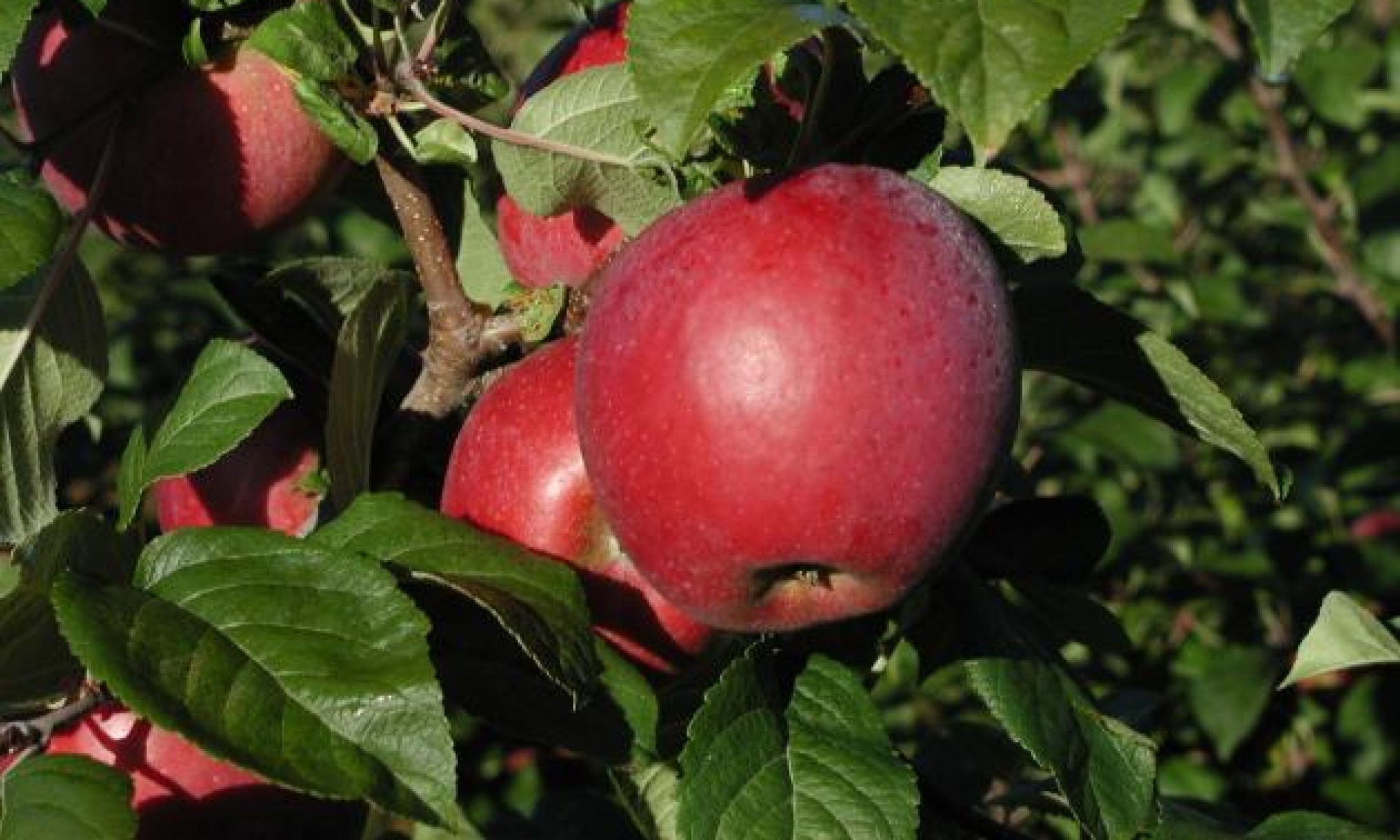
Nursery catalogs or their web sites often list apple pollination charts or recommend good apple varieties to use as pollinzers. Varieties listed in these charts have overlapping bloom periods and are effective pollinizers. However, some varieties, such as Winesap, Stayman, Mutsu, and Jonagold, produce sterile pollen and therefore cannot be used to pollinate other apple varieties. …
Does an apple cultivar ripen at the same time every year?
Not necessarily. Time of apple ripening is affected most by bloom date and growing season weather. For example, McIntosh typically ripens 125 Days After Full Bloom (DAFB), but can range from 115 to 135 DAFB. There are formula(s) for determining harvest timing, for example, this one for McIntosh from Cornell University. In any year the best indicator of maturity and harvest timing is a combination of flavor and fruit background and over-color, but the starch-iodine index test is also …
How many fruit should my apple tree bear each year?
Apple trees often set more fruit then they can adequately support. When a tree has too many fruit, the fruit tend to be small, poorly colored, and may have low sugar levels. Limb breakage may also result from over-cropping. In general, large trees can support more fruit then small trees, therefore the ideal number of fruit per tree varies with tree size. The number of fruit per tree can be based on the circumference of the trunk. To determine trunk
What is sunburn damage to apple fruit and how can it be prevented?
Sunburn damage is a skin discoloration of the exposed side of the fruit, and can be caused by several conditions. Sunburn can be prevented by cultural and chemical means. See this article on Sunburn of Apple for detailed information on symptoms and prevention.
… What is apple cork spot and can it be prevented with calcium sprays?
Apple cork spot is a physiological disorder that can affect apple quality and reduce visual appeal. Cork spot generally appears in the outer portion of the fruit flesh as small green dimples or depressions. This disorder may begin developing in June and continue throughout the initial stages of growth and enlargement. The green spots eventually enlarge to corky, discolored areas 1/4 to 1/2 inch into the flesh of the apple. The corky spots may occur anywhere on the fruit flesh.…
What is the proper way to pick an apple fruit from the tree?
Fruit should be grasped in the palm of the hand and rotated and lifted upward to remove them. The stem should remain attached to the apple. Never grasp the fruit with your finger tips or pull the fruit downward.…
Parts of an Apple Tree
When discussing apple rootstocks and cultivars, understanding the terminology used to describe the tree is important. All apple trees purchased from nurseries are grafted or budded, meaning that there are at least two distinct parts of the tree. The scion is the above ground or vegetative portion of a grafted or budded tree comprised of the trunk, branches, leaves, and fruit. The scion is the cultivar or the part of the tree that has name recognition such as Gala or …
Interstem Apple Trees
Because many dwarfing rootstocks have less than the desired level of cold resistance and trees on all dwarfing rootstocks require support, dwarf rootstocks are sometimes used as interstems to combine the desirable characteristics of a vigorous understock and the dwarfing interstem.
Interstem trees consist of three parts:
- A vigorous rootstock (usually MM.111 or MM.106)
- A dwarfing (usually M.9 or M.27) interstem is grafted to the rootstock. The interstem is usually about 6” long, but additional dwarfing can be obtained by
Apple Rootstock Info: G.890
| Characteristic | Detail | Description |
|---|---|---|
| Rootstock | G.890 |
G.890 is a semidwarfing rootstock that is resistant to fire blight (Erwinia amylovora), crown rot (Phytopthora spp.) and woolly apple aphid. At this time production of root suckers and burr knots is unknown. Tree size is approximately the same as M.7 but with higher and earlier production. |
| Synonyms | Geneva 890 | |
| Origin | N/A | |
| Availability | Limited availability | |
| Tree Size | 70-75% | |
| Precocity | Intermediate | |
| Winter Hardiness | Hardy | |
| Suckering | N/A | |
| Tree Support Needed | No | |
| Where tested within NC-140 or other |
Apple Rootstock Info: G.65
| Characteristic | Detail | Description |
|---|---|---|
| Rootstock | G.65 |
G.65 was developed by Dr. Jim Cummins at Cornell University. Due to errors in tissue culture buildup of this rootstock, the U.S. distribution of this rootstock has been hindered. Tree size once thought to be about that of M.9 is now considered to be closer to M.27. The rootstock is difficult to propagate in nursery stool beds. It is susceptible to tomato ring spot virus and apple stem grooving virus. Not recommended for commercial planting. |