Support for Apple Trees on Dwarfing Rootstocks


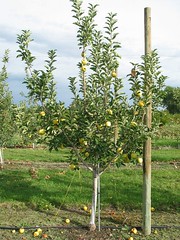
Dwarf apple tree supported by single wire and conduit with wooden posts no more than 50 ft. apart within the row. Photo: Jon Clements, University of Massachusetts Amherst.

When propagated on dwarfing rootstocks, most apple cultivars will lean or fall over as they start to fruit. Trees on dwarfing rootstocks tend to produce heavy crops relative to the size of the tree, and the tree cannot support the weight of the crop. Many dwarf rootstocks also produce relatively shallow, brittle …
Deer Damage on Apple Trees

White-tailed deer in the eastern United States are one of the leading causes of damage to crops, including many perennial crops such as apples (figs. 1, 2). Deer feed on dormant shoots as well as growing trees. Much research has gone into controlling deer by excluding them from orchards using fencing; frightening them with loud sounds; repelling them through different compounds, some as common as soap; and reducing the herd through contraception and, as a last resort, hunting.

Figure 1.

X-Spot of Apple

The names X-spot, X-rot, and Nigrospora spot have been applied to a small, circular, depressed, necrotic spot typically on the calyx end of apple fruit in the mid-Atlantic region (Fig. 1). Although uncommon, incidence of X-spot as high as 86% was reported on unprotected ‘Golden Delicious’ and ‘Rome Beauty’ fruit in 1950. Other susceptible cultivars include ‘Jonathan’, ‘Stayman Winesap’, and ‘York Imperial’.

Figure 1. X-spot is likely a fungal disease, although the pathogen is undetermined at this time. Photo: A.

Black Rot of Apple

Black rot is a fungus disease that can cause serious losses in apple orchards, especially in warm, humid areas. The black rot fungus covers a wide geographical range and can infect many hosts other than apple. The role these hosts play in the spread and development of the disease is not known. Three forms of the disease can occur: a leaf spot known as frogeye leaf spot, a fruit rot, and a limb canker. Severe leaf spotting can result in …

Hail Injury on Apple Trees and Fruit

Hail can injure apple fruit, shoots, and limbs. The extent of the injury usually depends on the size and shape of the hail and the duration of the event. Injury can range from torn or shredded leaves and small dents that don’t break the fruit skin to effects so severe that an entire crop is lost due to physical damage. In some cases, replacement of trees is necessary, especially when young trees have significant bark injury. Fungicide protection of injured …

Sources for Apple and Other Fruit Trees

Many nurseries supply fruit trees to commercial and home growers. We’ve assembled lists of some of these nurseries to help you source particular plant material or locate nurseries in your region. As Cooperative Extension educators, our goal is to provide you with basic information and resources to make informed decisions. These lists are for informational purposes only. They are neither comprehensive nor intended to promote any individual businesses.

U.S. Fruit Tree Nurseries

International Fruit Tree Nurseries

Fruit Tree Rootstock Nurseries

Fire Blight of Apple

Fire blight

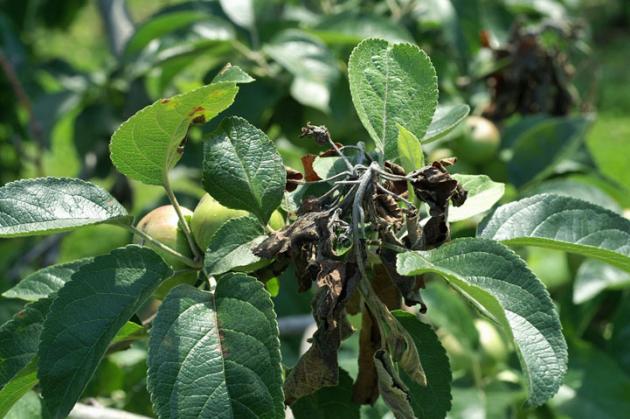
Figure 1. Blossom cluster and adjacent shoot with fire blight. (Alan R. Biggs, West Virginia University)

Fire blight is a destructive bacterial disease of apples and pears that kills blossoms, shoots, limbs, and, sometimes, entire trees (Figs. 1, 2). The disease is generally common throughout the United States wherever apples are grown. Outbreaks are typically very erratic, causing severe losses in some orchards in some years and little or no significant damage in others.

Fire blight

Figure 2. Apple shoot with fire …

Effect of Water on Apple Trees: Not Enough or Too Much?

One of the most common causes of tree decline or death is imbalance of water demand and supply.

Not Enough Water

When water demand of a fruit tree is higher than supply, drought stress occurs. Drought stress causes wilting, yellowing of the leaves, advanced leaf fall, and premature fruit ripening or fruit drop. Often, drought stress is associated with heat stress during the hot summer months. When drought stress and heat stress coincide, scorching of the leaves occurs in addition …

White Root Rot of Apple

White root rot, caused by the fungus Scytinostroma galactinum (formerly Corticium galactinum), has been known as a parasite of apple trees for many years and is widely distributed (Canada to Texas and westward to the Pacific coast, Europe, West Indies, and Japan). It occurs in both bearing and non-bearing apple orchards. Other hosts include a wide variety of woody plants, ornamental shrubs, and herbaceous perennials, including white pine, ash, peach, blackberry, dewberry, Japanese wineberry, dogwood, sumac, white campion, holly, …

Apple Mosaic Virus

Apple mosaic virus is one of the oldest known and most widespread apple viruses. The same virus can cause line pattern symptoms in plum and rose mosaic disease. Apple mosaic virus is related to Prunus necrotic ring spot virus.

Apple trees infected with apple mosaic virus develop pale to bright cream spots on spring leaves as they expand (fig. 1). These spots may become necrotic after exposure to summer sun and heat. Most commercial cultivars are affected, but severity of …