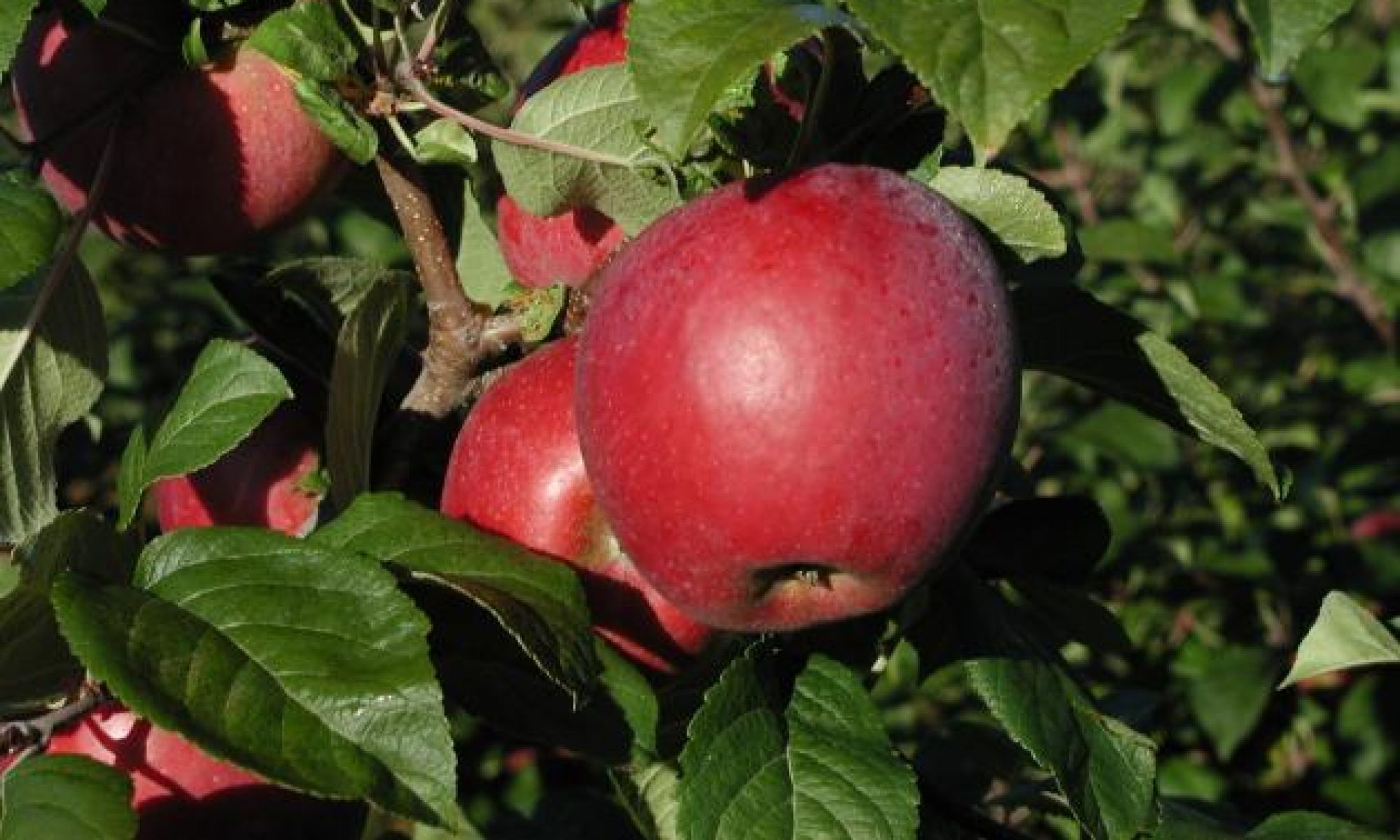
Time of harvest depends on the intended use of the apples. Apples that will be consumed immediately can be left on the tree longer than those intended for cold storage. Generally, fruit can be harvested from the tree over a couple of weeks. Fruit that drops from the tree is usually over ripe. To determine the approximate time of harvest, check a fruit tree nursery catalog or their web site for a list of harvest dates for various cultivars. These …
Apple Rootstock Info: V.3
| Characteristic | Detail | Description |
|---|---|---|
| Rootstock | V.3 |
The Vineland series of apple rootstocks originated as open-pollinated hybrids of ‘Kerr’ crabapples and M.9 rootstock and were selected at the Horticultural Experiment Station at Vineland, Ontario, Canada in 1958. According to information from the Ontario Ministry of Agriculture, Food and Rural Affairs, V.3 is slightly smaller than M.9 EMLA and yield and yield efficiency is similar to M.9 EMLA. V.3 is cold hardy and somewhat resistant to fireblight. V.3 was included in the 1994 |
Why did my apple trees bloom heavily but only set a few fruit?
There are several possibilities why apple trees bloom but fail to set fruit:
- Apples are not self-fertile and need another apple tree or tree(s) of another different variety (or varieties) so the flowers can be pollinated (by bees, see #2.) and set fruit.
- Apple flowers rely on bees to carry the pollen from one variety to another so the flower(s) can be pollinated and the fruit can set and begin to grow. Both domestic honeybees and wild pollinators (bees, wasps)
Apple Rootstock Info: Ottawa 3
| Characteristic | Detail | Description |
|---|---|---|
| Rootstock | Ottawa 3 |
Introduced by the Agriculture Canada Research Station in Ottawa, Ontario, Canada in 1974 as a hardy dwarfing rootstock. The parents were M.9 and ‘Robin’ crab. Ottawa 3 roots poorly in the stoolbed and is often micropropagated. Trees are precocious and produce few rootsuckers and burrknots. It is sensitive to apple stem grooving virus. Ottawa 3 was included in the 1990 NC-140 cultivar/rootstock trial at 12 locations and the 1990 dwarf rootstock trial at 8 |
How do I find out if two apple cultivars are effective to cross pollinate?
Nursery catalogs or their web sites often list apple pollination charts or recommend good apple varieties to use as pollinzers. Varieties listed in these charts have overlapping bloom periods and are effective pollinizers. However, some varieties, such as Winesap, Stayman, Mutsu, and Jonagold, produce sterile pollen and therefore cannot be used to pollinate other apple varieties. …
Apple Rootstock Info: P.2
| Characteristic | Detail | Description |
|---|---|---|
| Rootstock | P.2 |
Resulted from a cross of M.9 x Common Antonovka and released by the Research Institute of Poland in Skierniewice, Poland. This is a productive, cold hardy, dwarfing rootstock slightly more dwarfing than M.9 NAKBT-337. It is susceptible to fire blight, and wooly apple aphid, but fairly resistant to crown and root rots. It produces few root suckers and burr knots similar to M.9. In NC-140 trials trees survive; depaending on location tree size was similar |
How do I select the best "strain" of an apple cultivar?
In selecting the best strain of a cultivar it is important to talk to other fruit growers, cooperative extension personnel and nursery owners. Solicit advice from these groups that know your local growing conditions. Check to see if any of these people have trees of the strain you are interested in and visit their orchards to see fruit on the trees. If you are looking to plant large acreage of a particular strain you should set out a few trees, …
How Apple Tree Productivity Is Measured
The simplest approach to measuring productivity is to assess yield on a per-tree basis; it is straightforward and easy to understand. The problem comes when comparing trees of different sizes. For instance, comparing the productivity of apple trees on M.9 NAKBT337 and those on G.30 on a per-tree basis would be meaningless. The size of trees on M.9 NAKBT337 would allow much greater planting densities than would that of trees on G.30. Therefore, trees on M.9 NAKBT337 could have a …
Is there a chance that a scab-resistant apple cultivar will become scab-susceptible?
Yes, and several scab-resistant cultivars already are scab-susceptible at some locations. Most scab-resistant apples trace their origins to a collaboration between Purdue University, Rutgers University, and the University of Illinois. The PRI apple breeding program began in 1926 when crosses made from the crab apple, Malus floribunda 821, were found to show some resistance to apple scab. The PRI group then bred the resistant Vf gene from Malus floribunda 821 into commercial apple cultivars. Decades of subsequent hybridization and selection …
Apple Yield Efficiency
Pomological researchers have assessed other approaches to determining potential yield. Since planting density works together with per-tree yield to determine productivity per acre, researchers have used canopy dimensions to estimate planting density and then estimated potential yield per acre. This approach is perfect if the trees used to measure yield and canopy size are not contained by any pruning. Once the canopy is manipulated, and particularly if it is manipulated differently for trees of different sizes, potential yield per acre …