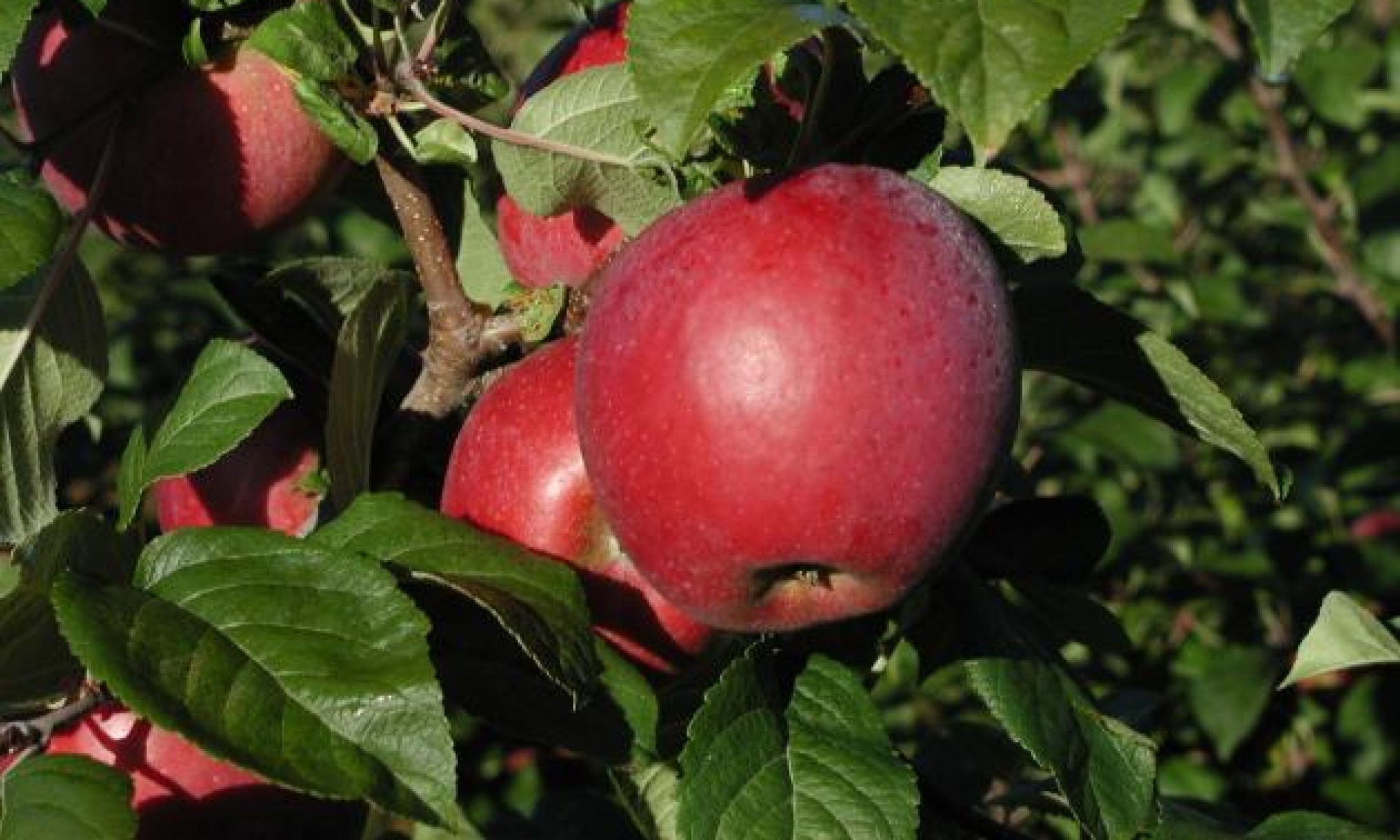
When discussing apple rootstocks and cultivars, understanding the terminology used to describe the tree is important. All apple trees purchased from nurseries are grafted or budded, meaning that there are at least two distinct parts of the tree. The scion is the above ground or vegetative portion of a grafted or budded tree comprised of the trunk, branches, leaves, and fruit. The scion is the cultivar or the part of the tree that has name recognition such as Gala or …
What are the most important apple traits that impact consumer preference?
Although a matter of personal preference, most agree the following apple traits affect consumer preference:
- Appearance — red apples are preferred over green or yellow apples by most. Good red color means the fruit has reached proper maturity and will eat well. Yellow and green apples, for example Golden Delicious and Granny Smith respectively, are preferred by some for their particular flavor and texture.
- Flavor — some people like tart apples (McIntosh), some like sweet apples (Gala), and some like
Interstem Apple Trees
Because many dwarfing rootstocks have less than the desired level of cold resistance and trees on all dwarfing rootstocks require support, dwarf rootstocks are sometimes used as interstems to combine the desirable characteristics of a vigorous understock and the dwarfing interstem.
Interstem trees consist of three parts:
- A vigorous rootstock (usually MM.111 or MM.106)
- A dwarfing (usually M.9 or M.27) interstem is grafted to the rootstock. The interstem is usually about 6” long, but additional dwarfing can be obtained by
Apple Rootstock Info: G.890
| Characteristic | Detail | Description |
|---|---|---|
| Rootstock | G.890 |
G.890 is a semidwarfing rootstock that is resistant to fire blight (Erwinia amylovora), crown rot (Phytopthora spp.) and woolly apple aphid. At this time production of root suckers and burr knots is unknown. Tree size is approximately the same as M.7 but with higher and earlier production. |
| Synonyms | Geneva 890 | |
| Origin | N/A | |
| Availability | Limited availability | |
| Tree Size | 70-75% | |
| Precocity | Intermediate | |
| Winter Hardiness | Hardy | |
| Suckering | N/A | |
| Tree Support Needed | No | |
| Where tested within NC-140 or other |
Do apples have a natural wax on the fruit surface?
Natural wax is present on the surface of apples. It repels moisture from the fruit surface and prolongs storage life of the fruit by reducing moisture loss from the flesh. On some apple varieties, such as Empire, it often is white in color and is called a waxy bloom. …
Apple Rootstock Info: G.65
| Characteristic | Detail | Description |
|---|---|---|
| Rootstock | G.65 |
G.65 was developed by Dr. Jim Cummins at Cornell University. Due to errors in tissue culture buildup of this rootstock, the U.S. distribution of this rootstock has been hindered. Tree size once thought to be about that of M.9 is now considered to be closer to M.27. The rootstock is difficult to propagate in nursery stool beds. It is susceptible to tomato ring spot virus and apple stem grooving virus. Not recommended for commercial planting. |
Do scab-resistant apple cultivars still need to be protected against scab infection?
Yes. Fungicide applications are an essential component of effective scab management, even though a cultivar may be resistant to the scab fungus. The fungicide applications contribute to the preservation of the plant’s resistance genes, which are subject to continuous evolutionary pressure from plant pathogens. For scab-resistant cultivars in particular, the most critical period for fungicide applications is during the primary infection cycle in the spring. Spores from over-wintered leaves on the ground are the “offspring” of the previous year’s infections …
Apple Rootstock Info: Supporter 1
| Characteristic | Detail | Description |
|---|---|---|
| Rootstock | Supporter 1 |
Resulted from a cross between M.9 and Malus baccata (L.) Borkh. Supporter 1 was tested at seven locations in the NC-140 1999 trial with ‘Fuji’ as the scion cultivar. Supporter 1 trees had good survival and trees were about 75% as big as M.9 NAKBT337, produced similar numbers of root suckers as M.9 and had slightly high yield efficiency than M.9. European tests indicate it is quite cold hardy. |
| Synonyms | Supp1 | |
| Origin | M9 X |
Besides the use of rootstocks what horticultural methods can I use to control apple tree size?
The primary method of controlling apple tree size is by using dwarfing rootstocks. While dwarfing rootstocks are the most common practice for controlling size in fruit trees, there are many other methods or techniques used to control the size and vigor of trees. Any practice increasing the harvest index or proportion of biomass going into fruits rather than wood or leaves will tend to reduce the size (total volume or biomass) and vigor (rate of growth) of trees. These horticultural …
Apple Rootstock Info: M.4
| Characteristic | Detail | Description |
|---|---|---|
| Rootstock | M.4 |
Selected in 1912 from unknown parents at the East Malling Research Station in Maidstone, Kent, England. M.4 is slightly dwarfing and produces a tree about 75-80% standard size. It is considered fairly precocious, and trees tend to lean and may require trunk support. M.4 is resistant to collar rot. In an Indian rootstock trial trees on M.4, MM.106, and MM.111 were all about the same size. Cumulative yield was greater than trees on MM.111, similar |