Powdery Mildew

Powdery mildew can be a persistent disease of susceptible apple cultivars throughout the United States. It is one of the most predominant diseases in the more arid apple growing areas. It is the only fungal apple disease that is capable of causing infection without wetting from rain or dew.

Powdery mildew causes whitish lesions on curled or longitudinally folded leaves, stunted whitish-gray twig growth evident on dormant shoots, and fruit russeting. Economic damage occurs in the form of aborted blossoms, …

Rust Diseases – Cedar apple rust and Quince rust

cedar apple rust
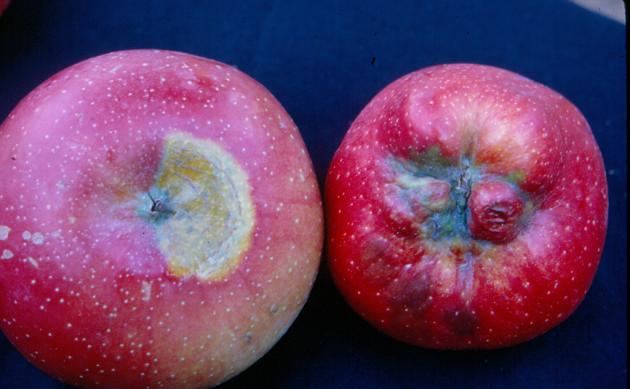
Figure 1. Apple rust diseases with cedar apple rust (left) and quince rust (right). Photo courtesy of Penn State University.

Cedar apple rust can infect leaves and fruit of most cultivars in the United States, where the alternate host, Eastern Red Cedar, occurs. A notable exception is ‘Delicious’, which is nearly immune.

The most conspicuous symptoms on apple are bright orange, glistening lesions on the leaves. Lesions which are not inhibited chemically may form small tufts of spore-producing structures (aecia) …

Sooty blotch and fly speck disease on apple

Sooty blotch and fly speck are caused by a complex of fungal pathogens that commonly appear together as surface blemishes on apple (and pear) in late summer and fall. Although these fungi may shorten the storage life of fruit due to increased water loss, they do not cause decay, and losses are attributed to unacceptable appearance. During wet growing seasons, losses of 25 percent or more are commonly found, even in orchards treated with fungicides. Sooty blotch appears as sooty …

What are different "strains" of the same apple cultivar?

Many cultivars of apples have multiple strains or selections which will have different names usually in front of the cultivar i.e. Grand Gala, Gale Gala, Fulford Gala, etc.  These different strains are all of the same cultivar with some unique characteristic usually relating to color, size, or maturity.   The availability of different strains is more prevalent in some cultivars than others.…

Why do some apples shrivel in storage and how can it be prevented?

Some apple cultivars shrivel during cold storage which is cultivar dependent.  One of the most common cultivars that this is a problem with is golden or yellow delicious due to a thinner layer of natural wax on the apple surface called the cuticle.  This natural wax is what causes apple to shine when rubbed on a cloth (“buffing”).   Although the apples are edible after shriveling, with pretty good flavor, it can be easily prevented.  Placing the apples in a plastic …

Is fruit firmness the best measure to determine when to harvest apple fruit?

Apple flesh firmness is one criteria that is used to determine the maturity, and quality, of apples.  However, it is not the best single  indicator to determine the harvest maturity for apples.  Apples are harvested at different stages of maturity depending on how long they will be in storage before marketing. Apples to be used shortly after harvest are tree ripened and picked at a much later stage of maturity than apples that will be stored for 6-9+ months.  Flesh …

Why did my trees only produce a few blossoms in the spring?

There are several reasons why an apple tree does not produce a full bloom:

It is possible that the tree is too young and is just beginning to become reproductive, that is produce flowers.  If this is the case, flowering should increase next year.

A young tree may be overly vigorous, spending its energy producing wood and leaves and not flowers.  Over fertilization is a possible cause.

Flower buds are formed 10 or 11 months prior to bloom, that is …

What is the difference between cork spot and bitter pit?

Cork spot and bitter pit are both physiological disorders of apples caused by low levels of calcium.  Visually, cork spots develop anywhere on the fruit, will be relatively small in number per fruit, are sunken and somewhat diffuse spots about 1/2 inch in diameter.  Beneath the spot will be a corky area extending into the flesh of the apple.  Bitter pit, on the other hand, develop only on the half of the apple opposite the stem, are smaller and a …

What does "low ethylene" apple cultivar mean?

Ethylene is a small gaseous molecule which is present in all plant tissues.  Interestingly, it is a plant hormone and is actively involved in many physiological processes.  One very important process in apples in which ethylene is intimately involved is ripening.  Specifically, ethylene is the triggering molecule for apple ripening.  If ethylene is removed from the fruit or its production is limited within the fruit, ripening will be slowed or, in some cases, nearly stopped.  Low-ethylene cultivars have an inherently …

What causes mis-shaped apple fruit?

Fruit shape is affected by many factors.  Mis-shapen fruit can result from insect or disease damage.  Tarnished plant bug and plum curculio attack very young fruit.  When that fruit matures, it often develops abnormally. 

Probably, one of the most common causes of mis-shapen fruit is the development of seeds within the fruit.  If seed development is dispersed around the core of the apple, usually the fruit will develop well and symmetrically.  If the seeds develop only on one side of …