Rust Diseases – Cedar apple rust and Quince rust

cedar apple rust
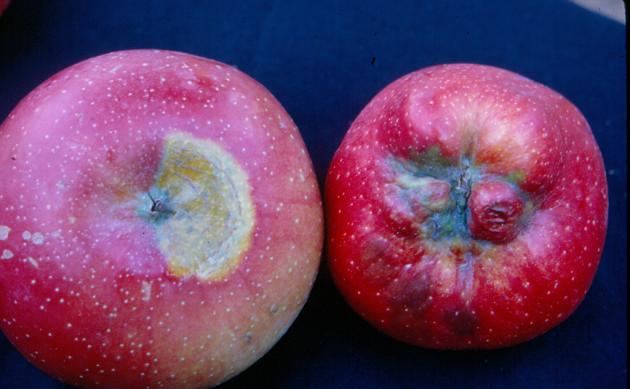
Figure 1. Apple rust diseases with cedar apple rust (left) and quince rust (right). Photo courtesy of Penn State University.

Cedar apple rust can infect leaves and fruit of most cultivars in the United States, where the alternate host, Eastern Red Cedar, occurs. A notable exception is ‘Delicious’, which is nearly immune.

The most conspicuous symptoms on apple are bright orange, glistening lesions on the leaves. Lesions which are not inhibited chemically may form small tufts of spore-producing structures (aecia) …

Sooty blotch and fly speck disease on apple

Sooty blotch and fly speck are caused by a complex of fungal pathogens that commonly appear together as surface blemishes on apple (and pear) in late summer and fall. Although these fungi may shorten the storage life of fruit due to increased water loss, they do not cause decay, and losses are attributed to unacceptable appearance. During wet growing seasons, losses of 25 percent or more are commonly found, even in orchards treated with fungicides. Sooty blotch appears as sooty …

Fire blight

Fire blight is a destructive bacterial disease of apples and pears that kills blossoms, shoots, limbs, and, sometimes, entire trees. The disease is generally common in most apple-growing regions of the US; although, outbreaks are typically very erratic, causing severe losses in some orchards in some years and little or no significant damage in others. This erratic occurrence is attributed to differences in the availability of overwintering inoculum, the specific requirements governing infection, variations in specific local weather conditions, and …

Apple Rootstock Info: Mark

Characteristic Detail Description
Rootstock Mark

An open-pollinated seedling of M.9 and introduced by Michigan state University, USA in 1979. It is a virus-free clone of MAC-9. Mark is a hardy, precocious dwarfing rootstock. It is susceptible to fire blight and fairly resistant to crown and root rots, produces many burr knots and few root suckers. Mark requires tree support. Trees are very precocious and tree vigor may decline earlier than desired when young trees are allowed to produce heavy crops

Apple Rootstock Info: MM.111 EMLA

Characteristic Detail Description
Rootstock MM.111 EMLA

Introduced in 1952 from a cross of Merton 793 x ‘Northern Spy’ by the John Innes Horticultural Institute and the East Malling Research Station in England. MM.111 EMLA is one of the more vigorous semi-dwarf rootstocks, producing a tree about 85 to 100% the size of seedling. It is resistant to wooly apple aphid and is quite tolerant to fire blight and crown and root rots. It is fairly winter hardy and produces moderate

Apple Rootstock Info: MM.106 EMLA

Characteristic Detail Description
Rootstock MM.106 EMLA

Selected in 1932 from a cross of M.2 x ‘Northern Spy’ by the John Innes Horticultural Institute and the East Malling Research Station in England. MM.106 EMLA is a semi-dwarf rootstock, producing a tree about 60% the size of seedling. It is quite precocious and productive and usually does not need tree support. It is resistant to wooly apple aphid, but is highly susceptible to crown and root rots, susceptible to fire blight, and

Apple Rootstock Info: M.27 EMLA

Characteristic Detail Description
Rootstock M.27 EMLA

Selected in 1934 from a cross of M.13 x M.9 at East Malling Research station in Maidstone, Kent, England and was tested as Malling 3431. M.27 EMLA is a very dwarfing rootstock and is probably too dwarfing for most commercial situations except for vigorous cultivars on vigorous sites, but it might be considered for home gardens where a small tree is desirable.. Trees on M.27 EMLA are very precocious and productive and require permanent

What are different "strains" of the same apple cultivar?

Many cultivars of apples have multiple strains or selections which will have different names usually in front of the cultivar i.e. Grand Gala, Gale Gala, Fulford Gala, etc.  These different strains are all of the same cultivar with some unique characteristic usually relating to color, size, or maturity.   The availability of different strains is more prevalent in some cultivars than others.…

Why do some apples shrivel in storage and how can it be prevented?

Some apple cultivars shrivel during cold storage which is cultivar dependent.  One of the most common cultivars that this is a problem with is golden or yellow delicious due to a thinner layer of natural wax on the apple surface called the cuticle.  This natural wax is what causes apple to shine when rubbed on a cloth (“buffing”).   Although the apples are edible after shriveling, with pretty good flavor, it can be easily prevented.  Placing the apples in a plastic …

Is fruit firmness the best measure to determine when to harvest apple fruit?

Apple flesh firmness is one criteria that is used to determine the maturity, and quality, of apples.  However, it is not the best single  indicator to determine the harvest maturity for apples.  Apples are harvested at different stages of maturity depending on how long they will be in storage before marketing. Apples to be used shortly after harvest are tree ripened and picked at a much later stage of maturity than apples that will be stored for 6-9+ months.  Flesh …