- Apple Rootstock Characteristics and Descriptions
- Publications from the NC-140 Regional Rootstock Research Project
- Understanding Apple Tree Size: Dwarf, Semi-Dwarf and Standard
- Controlling Apple Tree Size by Horticultural Means
- Apple Rootstock Influence on Precocity
- Apple Tree Productivity
- Winter Hardiness of Apple Rootstocks
- Apple Rootstock Testing and NC-140
- Support for Apple Trees on Dwarfing Rootstocks
- Apple Rootstocks and Suckering
- Apple Rootstocks and Virus Status
- Interstem Apple Trees
- Parts of an Apple Tree
- Table of Apple Rootstock Susceptibility to Phytophthora spp.
Powdery Mildew
Powdery mildew can be a persistent disease of susceptible apple cultivars throughout the United States. It is one of the most predominant diseases in the more arid apple growing areas. It is the only fungal apple disease that is capable of causing infection without wetting from rain or dew.
Powdery mildew causes whitish lesions on curled or longitudinally folded leaves, stunted whitish-gray twig growth evident on dormant shoots, and fruit russeting. Economic damage occurs in the form of aborted blossoms, …
Rust Diseases – Cedar apple rust and Quince rust
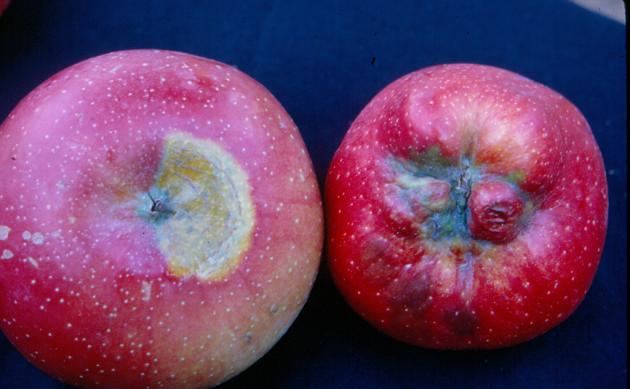
Figure 1. Apple rust diseases with cedar apple rust (left) and quince rust (right). Photo courtesy of Penn State University.
Cedar apple rust can infect leaves and fruit of most cultivars in the United States, where the alternate host, Eastern Red Cedar, occurs. A notable exception is ‘Delicious’, which is nearly immune.
The most conspicuous symptoms on apple are bright orange, glistening lesions on the leaves. Lesions which are not inhibited chemically may form small tufts of spore-producing structures (aecia) …
Sooty blotch and fly speck disease on apple
Sooty blotch and fly speck are caused by a complex of fungal pathogens that commonly appear together as surface blemishes on apple (and pear) in late summer and fall. Although these fungi may shorten the storage life of fruit due to increased water loss, they do not cause decay, and losses are attributed to unacceptable appearance. During wet growing seasons, losses of 25 percent or more are commonly found, even in orchards treated with fungicides. Sooty blotch appears as sooty …
Fire blight
Fire blight is a destructive bacterial disease of apples and pears that kills blossoms, shoots, limbs, and, sometimes, entire trees. The disease is generally common in most apple-growing regions of the US; although, outbreaks are typically very erratic, causing severe losses in some orchards in some years and little or no significant damage in others. This erratic occurrence is attributed to differences in the availability of overwintering inoculum, the specific requirements governing infection, variations in specific local weather conditions, and …
Why did my trees only produce a few blossoms in the spring?
There are several reasons why an apple tree does not produce a full bloom:
It is possible that the tree is too young and is just beginning to become reproductive, that is produce flowers. If this is the case, flowering should increase next year.
A young tree may be overly vigorous, spending its energy producing wood and leaves and not flowers. Over fertilization is a possible cause.
Flower buds are formed 10 or 11 months prior to bloom, that is …
What is the difference between cork spot and bitter pit?
Cork spot and bitter pit are both physiological disorders of apples caused by low levels of calcium. Visually, cork spots develop anywhere on the fruit, will be relatively small in number per fruit, are sunken and somewhat diffuse spots about 1/2 inch in diameter. Beneath the spot will be a corky area extending into the flesh of the apple. Bitter pit, on the other hand, develop only on the half of the apple opposite the stem, are smaller and a …
Apple Tree Viruses
Virus and Other Graft-Transmissible Diseases and Disorders of Apples
Virus diseases cause economic losses through lower yields and reduced quality of apples and apple products. In general, virus diseases in perennial crop plants, such as apples, are more potentially damaging than in annual crops. Viruses can remain latent, spreading through an orchard and inflicting damage, often without the growers’ knowledge. Latent virus infection can produce small to moderate losses in fruit production. Often growers can maintain the productivity of diseased …
Apple Rootstock Info: M.7 EMLA
| Characteristic | Detail | Description |
|---|---|---|
| Rootstock | M.7 EMLA |
Formerly known as EM VII. Selected in 1912 from unknown parentage at the East Malling Research station in Maidstone, Kent, England. Trees on M.7 EMLA produce a semi-dwarf tree about 60 to 70% as big as seedling. Trees are moderately precocious and may lean with some cultivars and may require trunk support. Trees tend to produce many rootsuckers. M.7 EMLA has been widely planted since the 1960s with cultivars such as ‘McIntosh’, ‘Empire’, ‘Cortland’, |
Apple Rootstock Info: B.9
| Characteristic | Detail | Description |
|---|---|---|
| Rootstock | B.9 |
Resulted from a cross of M.8 x ‘Red Standard’ (Krasnij Standard) from Russia. B.9 has been tested widely and is used commercially in the U.S. In general, B.9 is slightly more dwarfing than M.9 and has slightly higher yield efficiency than M.9. B.9 was selected as a dwarfing cold hardy rootstock and initial inoculation results indicated that it was as susceptible to fire blight as M.9. However, in field trials, trees grafted onto B.9 survived |